Introduction
Introduction: The Visual and Material Worlds of James VI and I
By Jemma Field Catriona Murray
In these remarks, penned in 1599 as counsel to his elder son and heir, Henry Frederick, King James VI demonstrated his acute awareness of being seen. He explained that the outer man presented to public scrutiny reflects the inner self, yet cautioned that appearances are perilous things: public show may deceive, and audiences may misread.2 James’s sensitivity to perception and context—when applied to the royal image—was made manifest just a few years later. In 1601 the civic official Archibald Cornwall was hanged for attempting to display portraits of the king and queen (part of a sale of confiscated goods) from a gibbet.3 The dishonour done to the king’s portrait was deemed an affront to his person. Once more, the fraught relationship between regal outward appearance and inward self was revealed. Even before his accession to the English throne and exposure to a sophisticated court apparatus for the production of royal imagery, therefore, James was deeply concerned with visual representation and its reception.
2Despite this, scholarly engagement with James as a monarch attuned to the politics and possibilities of visual and material display remains limited. Marking the four-hundred-year anniversary of his death, the National Galleries of Scotland’s recent exhibition The World of King James VI & I (28 April–14 September 2025) has once again exposed the king to public show.4 Bringing together state portraits, luxury objects, dress, miniature paintings, jewellery, rare books, and manuscripts, the exhibition restaged the rich material programmes of the Jacobean era. This special issue builds on that renewed public interest, advancing a scholarly reappraisal of a monarch and court whose artistic endeavours have too often remained obscured. It arose from a shared recognition—born of both curiosity and frustration—that no publication had yet treated the visual and material culture of James’s reign in a sustained and integrated way. Despite the richness and diversity of artistic production across his courts, from Edinburgh to London, scholars and students alike have lacked a cohesive framework for understanding how the Jacobean world looked, felt, and functioned. Our aim in assembling this collection is therefore both corrective and generative: to challenge the persistent assumption that James was indifferent to art, and to demonstrate instead the vitality, sophistication, and ambition of the visual cultures that flourished under his rule. In doing so, we seek to reposition Jacobean culture within a broader geography that embraces the British Isles as a whole—Scotland, England, Ireland, and Wales—as well as its circuits of global exchange, revealing a court that was neither provincial nor isolated but deeply enmeshed in the artistic, diplomatic, and commercial currents of its time.
4James (VI and) I and the Art Historians
In recent decades several historians have taken as their subject the shifting reputation and historiography of James VI and I.5 However, the visual and material legacies of king and court, as well as their historical reception, have sparked little debate and only recent revisionism. In common with the monarch’s dubious biographical standing, we have the disaffected former courtier Anthony Weldon to thank for the disregard to which James’s artistic endeavours have been subjected. In the opening remarks of his memoir, first published in 1650, Weldon asserted: “The Kings Character is much easier to take then hi[s] Picture, for he could never be brought to sit for the taking of that which is the reason of so few good peeces of him”.6 Indeed, given the mental image that the author conjured of the unfortunate king, awkward in bearing and ill-favoured in countenance, with rolling eyes, thinning beard, and lolling tongue, the contemporary reader was not encouraged to seek out his royal portraiture. This stigmatisation of James’s visual representation was extended to his artistic judgement in the following century. In his Anecdotes of Painting in England (1762–80), Horace Walpole’s estimation of James’s patronage was scathing: “It was well for the arts that King James had no disposition to them: He let them take their own course. Had he felt any inclination for them, he would probably have introduced as bad a taste as he did into literature”.7
5The nineteenth century saw little improvement in the assessment of the Jacobean arts. In terms of the development of a national style or school, James’s reign was positioned as a dull hiatus between the decorous elegance of Nicholas Hilliard and his contemporaries and the baroque glamour of Anthony van Dyck. In one of the earliest attempts at an art historical account of the British Isles, from prehistory to the present day, James was designated a disappointing patron, since under his rule there “does not appear to have been any extraordinary movement in the arts”.8 At the same time, the nineteenth-century public were increasingly exposed to growing and diverse historical cultures through popular histories, historicised fiction, and historical illustration.9 Here too James was relegated. His history was lost between the increasingly romantic depiction of his tragic mother, Mary, Queen of Scots, and the partisan portrayals of his hapless son Charles I. The public’s visual imagination of the king, where it existed, was also decidedly unappealing. A burgeoning school of historical painting took its lead from eminent scholars of the time, such as T. B. Macaulay, who derided the king’s cowardice, pettiness, and pedantry. Betraying a scotophobic bias that taints much of James’s historiography, Macaulay includes the king’s “provincial accent” among the list of his faults.10 Sir John Gilbert’s watercolour Guy Fawkes before King James (1869) pictorialises this negative attitude (fig 1). Here, despite his bonds, an indignant and dignified Fawkes scowls at an ungainly James, hunched and dressed in night cap, complete with white feather—a long-standing symbol of cowardice.
8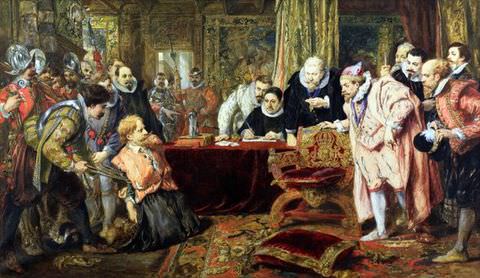
It was on these ignominious foundations that twentieth-century scholarship grew, often conflating James’s own reputed ugliness with that of the arts of his reign. In The English Face, first published in 1957, David Piper contrasts Elizabethan portraiture’s “richness and variety” with that of the succeeding reign, which demonstrated “no radical originality”.11 Nevertheless, in the aptly titled chapter “Jacobean Melancholy”, Piper praises the surviving imagery of luminaries, John Donne, Ben Jonson, and Francis Bacon, yet asserts that it is the sitters’ charisma that breaks the staid aesthetic conventions of the era.12 Considering James and his apparent physical defects, Piper judges his portraiture to be “composed near enough to dignity not to disgrace majesty”.13 Gradually, though, reassessment of Jacobean artistic endeavour began to take hold. In his largely critical cultural history Jacobean Pageant, G. P. V. Akrigg drew attention to the increasing exposure to continental influences and the emerging circle of connoisseur collectors at James’s court, even crediting this shift to the king’s cosmopolitan outlook.14 Two decades later, Roy Strong argued that the dawning of a new era in England’s art was underway at the court of James’s elder son, Henry Frederick, Prince of Wales. Had this remarkable prince survived, Strong asserted, England would have been at the forefront of a continental mannerist movement, aligned with a robustly Protestant outlook.15 James, however, was given no credit for this initiative, positioned as wholly counter to his son’s interests and as “totally unaesthetic”.16
11Recent re-evaluation of artistic endeavour at the Jacobean court has similarly focused on James’s family—his queen and his children—and his favourites.17 In particular, the patronage of Anna of Denmark has been reconsidered and she, in turn, revealed as a shrewd cultural force.18 This shift in scholarly focus has been accompanied by an expansion of Jacobean geographies and a broadening of artistic materials. Adopting a long view of James’s reign, important research has been undertaken into Scottish court patronage in the decades prior to and following his English accession.19 New insights have also been gleaned into cultural exchange across an international network of princely courts.20 Artistic definitions have also expanded to incorporate a panoply of visual and material display beyond painting, sculpture, and architecture. Festival, stage design, gardens, dress, jewellery, furniture, engravings, woodcuts, medals, and coinage have all been incorporated into the realms of courtly communication and persuasion. Nevertheless, despite this art historical reassessment of the court, James himself continues to feel removed. There is still no monograph devoted to the diverse artistic engagement of a monarch who patronised or encouraged a range of artificers, including George Heriot, Esther Inglis, David Ramsay, Nicholas Hilliard, John de Critz, Nicholas Stone, Inigo Jones, Simon de Passe, Daniel Mytens, and Peter Paul Rubens.
17Repositioning the King: From Caricature to Complexity
Set against this long tradition of caricature, neglect, and piecemeal reassessment, this collection seeks to reposition James’s reign within a richer visual and material landscape. Rather than treating his patronage as a disappointing interlude, the articles here demonstrate how art, objects, gesture, and performance were central to the projection of authority, the negotiation of favour, and the making of dynastic identity. By expanding the definition of artistic culture to include books, jewellery, prints, limnings, banquets, and bodily display, they move beyond the confines of traditional “fine art” to reveal a court alive with innovation and complexity. The result is an issue that highlights both the impressive breadth of visual material under consideration and the methodological diversity—queer theory, performance studies, microhistory—that allows these fragments to be reassembled.
Although this special issue does not follow a strictly chronological structure, it nevertheless traces the arc of James’s life and reign. Born in Edinburgh in 1566 and proclaimed “the cradle king” after his mother’s forced abdication the following year, James ruled Scotland for thirty-six years before succeeding his childless cousin Queen Elizabeth I in 1603, and thereby assuming the rule of England, Ireland, and Wales. He reigned for a further twenty-two years until his death in 1625, pursuing a vision of a unified “Kingdom of Great Britain” while overseeing overseas expansion, marked by the permanent settlement of Jamestown, Virginia, in 1607.
One of the most persistent questions—long colouring perceptions of James’s reign—is that of his sexuality. Rather than seeking a definitive answer in terms of modern categories of sexual orientation, the contributions here consider how his kingship was articulated through style: public gestures, objects, and spatial choreographies that made favouritism legible, provocative, and politically effective. That style was neither contained nor uncontested. Graphic satires lampooned the nexus of clientage, scandal, and sartorial display, projecting private intimacies into the public domain and complicating the politics of favour.
Much of the material evidence for Jacobean culture is, by its nature, fleeting. Entertainments dissolved in a single night, feasts left behind only bills and scattered descriptions, and garments and jewels were continually remade or were lost. What survives is fragmentary—letters, prints, wardrobe accounts—offering glimpses rather than complete records. Working with such patchy archives raises methodological challenges: how do we draw meaning from fragments or chart cultural influence across gaps? Several contributions in this issue engage directly with these problems, showing how the careful, contextualised reading of scattered traces can yield insights into the politics of patronage, memory, and diplomacy.
The issue also highlights how court culture functioned as diplomacy in action. Feasts, seating plans, and gifts mattered as much as masques and architecture in shaping relations with ambassadors and signalling alignments abroad. The banqueting houses of Whitehall, old and new, became stages where civility, empire, and transatlantic encounters were rehearsed before audiences both domestic and colonial. Meanwhile, the circulation of James’s likeness—through miniatures, engravings, and illuminated books—extended his presence across Europe, transforming his image into a brand that fuelled commerce as well as politics. These visualisations were never neutral; they invited affective bonds but could just as easily fracture allegiances.
Taken together, the articles gathered here do more than resituate James’s reputation—they open a new agenda for Jacobean studies. They reveal a court where sexuality was refracted through style, where mourning and dynastic ambition intertwined, and where material culture—from the smallest limning to the grandest banquet—communicated messages of power, allegiance, and identity. They also remind us that the Jacobean court cannot be understood in isolation: it was deeply entangled with European diplomacy, colonial expansion, and shifting confessional politics. Much remains deserving of further study—from the cultural traditions and innovations in Ireland and Wales to the reception of royal imagery across wider publics and its intersections with global trade.
This special issue repositions the Jacobean court as a site of artistic experiment and political negotiation. It demonstrates how image, intimacy, and allegiance operated in concert—mutually producing the affective and political fabric of kingship itself. In reframing James’s visual and material worlds, this issue makes a sustained case for their centrality to understanding early modern England and Scotland’s cultures of power.
Acknowledgements
The editors would like to thank the team at British Art Studies for their commitment to, and guidance throughout, this special issue, especially Alixe Bovey, Baillie Card, Chloe Julius, Tom Powell, Maisoon Rehani, Tom Scutt, and Sarah Victoria Turner. We are grateful to all of our contributors across the articles and features for their expertise, care, and enthusiasm, as well as to the anonymous peer reviewers, who play a vital—and often unsung—role in shepherding research to publication. Special thanks go to Catharine MacLeod and Charlotte Bolland for their generosity and insight during the study day in July 2024 that helped shape the content and direction of this issue. Finally, we are indebted to our families, friends, dogs, and cat, who have provided support, encouragement, and occasional distraction throughout this project.
About the authors
-
 Catriona Murray is Senior Lecturer in History of Art at the University of Edinburgh. She is a specialist in the art, objects, and performances of the Tudor and Stuart courts and has published widely on topics from seventeenth-century print culture to nineteenth-century historiography. Her first book, Imaging Stuart Family Politics: Dynastic Crisis and Continuity (Routledge, 2016), explored the strategic promotion of royal familial imagery as a compelling but ultimately precarious art of political communication. She is currently completing her second book, which considers the Stuart dynasty’s involved relationship with statuary and monuments, analysing how sculpture served to mediate royal authority, public loyalty, and political opposition.
 -
 Jemma Field is Associate Head of Research at the Yale Center for British Art. A cultural historian and museum leader, she specialises in early modern dress, gender, and identity politics. She has published in Costume, Northern Studies, The Court Historian, and Women’s History Review, and contributed multiple chapters in edited volumes. Her first monograph, Anna of Denmark: The Material and Visual Culture of the Stuart Courts, 1589–1619, was published by Manchester University Press in 2020. Her current research investigates the wardrobe of King Charles I of England, demonstrating how the dressed body legitimised political authority, articulated constructs of gender and sexuality, and expressed ambition and power.
Footnotes
-
1
James VI and I, Basilikon Doron (Edinburgh: Robert Waldegrave, 1599), 121. ↩︎
-
2
James VI and I, Basilikon Doron, 121–22. ↩︎
-
3
David Calderwood, The History of the Kirk of Scotland, vol. 6 (Edinburgh: Wodrow Society, 1845), 105. ↩︎
-
4
See also the accompanying publication, Kate Anderson, with Catriona Murray, Jemma Field, Anna Groundwater, Karen Hearn, and Liz Louis, Art & Court of James VI & I (Edinburgh: National Galleries of Scotland, 2025). ↩︎
-
5
See, for example, Marc Schwarz, “James I and the Historians: Toward a Reconsideration”, Journal of British Studies 13, no. 2 (May 1974): 114–34; Jenny Wormald, “James VI and I: Two Kings or One?”, History 68, no. 223 (1983): 187–209; Maurice Lee, “James I and the Historians: Not a Bad King After All?”, Albion: A Quarterly Journal Concerned with British Studies 16, no. 2 (Summer 1984): 151–63; Ralph Houlbrooke, “James’s Reputation 1625–2005”, in James VI and I: Ideas, Authority, and Government, ed. Ralph Houlbrooke (London: Routledge, 2016), 169–90; and Michael Corrie Questier, “The Reputation of James VI and I Revisited”, Journal of British Studies 61, no. 4 (October 2022): 949–69. ↩︎
-
6
Anthony Weldon (attrib.), The Court and Character of King James (London: John Wright, 1650), 56. ↩︎
-
7
Horace Walpole, Anecdotes of Painting in England, vol. 2 (London: Thomas Farmer, 1762), 1. ↩︎
-
8
W. B. Sarfield Taylor, The Origin, Progress and Present Condition of the Fine Arts in Britain and Ireland, vol. 1 (London: Whitaker, 1841), 292. ↩︎
-
9
Catriona Murray, “Reimagining the Family of King Charles I in Nineteenth-Century British Painting”, Historical Journal 65, no. 4 (2021): 1038. ↩︎
-
10
T. B. Macaulay, The History of England from the Accession of James II, vol. 1 (Cambridge: Cambridge University Press, 2011), 74. ↩︎
-
11
David Piper, The English Face (London: National Portrait Gallery, 1992), 61, 65. ↩︎
-
12
Piper, The English Face, 68. ↩︎
-
13
Piper, The English Face, 66. ↩︎
-
14
G. P. V. Akrigg, Jacobean Pageant or the Court of King James I (London: Hamish Hamilton, 1962), 272–73. ↩︎
-
15
Roy Strong, Henry, Prince of Wales and England’s Lost Renaissance (London: Thames & Hudson), 219. ↩︎
-
16
Strong, Henry, Prince of Wales, 15. ↩︎
-
17
See, for example, Timothy Wilks, ed., Prince Henry Revived: Image and Exemplarity in Early Modern England (London: Paul Holberton, 2007); Christiane Hille, Visions of the Courtly Body: The Patronage of George Villiers, First Duke of Buckingham and the Triumph of Painting at the Stuart Court (Munich: Akademie Verlag, 2012); Catharine MacLeod, ed., The Lost Prince: The Life and Death of Henry Stuart (London: National Portrait Gallery, 2012); Catriona Murray, Imaging Stuart Family Politics: Dynastic Crisis and Continuity (Abingdon: Routledge, 2017); Jemma Field, Anna of Denmark: The Material and Visual Culture of the Stuart Courts, 1589–1619 (Manchester: Manchester University Press, 2020); and Sara Ayres, Danish–British Consort Portraiture, c.1600–1900 (London: Lund Humphries, 2023). ↩︎
-
18
See, for example, Leeds Barroll, Anna of Denmark, Queen of England: A Cultural Biography (Philadelphia: University of Pennsylvania Press, 2001); Clare McManus, Women on the Renaissance Stage and Female Masquing in the Stuart Court, 1590–1619 (Manchester: Manchester University Press, 2002); Susan Dunn-Hensley, Anna of Denmark and Henrietta Maria: Virgins, Witches and Catholic Queens (Cham: Palgrave Macmillan, 2017); and Field, Anna of Denmark. ↩︎
-
19
Recent publications that shed significant new light on the visual and material cultures of the Scottish court include Field, Anna of Denmark; Maria Hayward, Stuart Style: Monarchy, Dress and the Scottish Male Elite (New Haven, CT: Yale University Press, 2020); Anna Groundwater, ed., Decoding the Jewels: Renaissance Jewellery in Scotland (Leiden: Sidestone Press, 2024). ↩︎
-
20
See, for example, Tracey A. Sowerby, “Negotiating the Royal Image: Portrait Exchanges in Elizabethan and Early Stuart Diplomacy”, in Early Modern Exchanges: Dialogues between Nations and Cultures, 1550–1750, ed. Helen Hackett (London: Routledge, 2016), 119–41; and Christiane Hille, “Gems of Sacred Kingship: Faceting Anglo-Mughal Relations around 1600”, in The Nomadic Object: The Challenge of World for Early Modern Religious Art, ed. Christine Göttler and Mia Mochizuki (Leiden: Brill, 2017), 291–318. ↩︎
Bibliography
Akrigg, G. P. V. Jacobean Pageant or the Court of King James I. London: Hamish Hamilton, 1962.
Anderson, Kate, with Catriona Murray, Jemma Field, Anna Groundwater, Karen Hearn, and Liz Louis. Art & Court of James VI & I. Edinburgh: National Galleries of Scotland, 2025. Exhibition catalogue: National Galleries of Scotland.
Ayres, Sara. Danish–British Consort Portraiture, c.1600–1900. London: Lund Humphries, 2023.
Barroll, Leeds. Anna of Denmark, Queen of England: A Cultural Biography. Philadelphia: University of Pennsylvania Press, 2001.
Calderwood, David. The History of the Kirk of Scotland. Vol. 6. Edinburgh: Wodrow Society, 1845.
Dunn-Hensley, Susan. Anna of Denmark and Henrietta Maria: Virgins, Witches and Catholic Queens. Cham: Palgrave Macmillan, 2017.
Field, Jemma. Anna of Denmark: The Material and Visual Culture of the Stuart Courts, 1589–1619. Manchester: Manchester University Press, 2020.
Groundwater, Anna, ed. Decoding the Jewels: Renaissance Jewellery in Scotland. Leiden: Sidestone Press, 2024.
Hayward, Maria. Stuart Style: Monarchy, Dress and the Scottish Male Elite. New Haven, CT: Yale University Press, 2020.
Hille, Christiane. “Gems of Sacred Kingship: Faceting Anglo-Mughal Relations around 1600”. In The Nomadic Object: The Challenge of World for Early Modern Religious Art, edited by Christine Göttler and Mia Mochizuki, 291–318. Leiden: Brill, 2017.
Hille, Christiane. Visions of the Courtly Body: The Patronage of George Villiers, First Duke of Buckingham and the Triumph of Painting at the Stuart Court. Munich: Akademie Verlag, 2012.
Houlbrooke, Ralph. “James’s Reputation, 1625–2005”. In James VI and I: Ideas, Authority, and Government, edited by Ralph Houlbrooke, 169–90. London: Routledge, 2016.
James VI and I. Basilikon Doron. Edinburgh: Robert Waldegrave, 1599.
Lee, Maurice. “James I and the Historians: Not a Bad King After All?”. Albion: A Quarterly Journal Concerned with British Studies 16, no. 2 (Summer 1984): 151–63.
Macaulay, T. B. The History of England from the Accession of James II. Vol. 1. Cambridge: Cambridge University Press, 2011.
MacLeod, Catharine, ed. The Lost Prince: The Life and Death of Henry Stuart. London: National Portrait Gallery, 2012.
McManus, Clare. Women on the Renaissance Stage and Female Masquing in the Stuart Court, 1590–1619. Manchester: Manchester University Press, 2002.
Murray, Catriona. Imaging Stuart Family Politics: Dynastic Crisis and Continuity. Abingdon: Routledge, 2017.
Murray, Catriona, “Reimagining the Family of King Charles I in Nineteenth-Century British Painting”. Historical Journal65, no. 4 (2021): 1035–59.
Piper, David. The English Face. London: National Portrait Gallery, 1992.
Questier, Michael Corrie. “The Reputation of James VI and I Revisited”. Journal of British Studies 61, no. 4 (October 2022): 949–69.
Schwarz, Marc. “James I and the Historians: Toward a Reconsideration”. Journal of British Studies 13, no. 2 (May 1974): 114–34.
Sowerby, Tracey A. “Negotiating the Royal Image: Portrait Exchanges in Elizabeth and Early Stuart Diplomacy”. In Early Modern Exchanges: Dialogues between Nations and Cultures, 1550–1750, edited by Helen Hackett, 119–41. London: Routledge, 2016.
Strong, Roy. Henry, Prince of Wales and England’s Lost Renaissance. London: Thames & Hudson.
Taylor, W. B. Sarfield. The Origin, Progress and Present Condition of the Fine Arts in Britain and Ireland. Vol. 1. London: Whitaker, 1841.
Walpole, Horace. Anecdotes of Painting in England. Vol. 2. London: Thomas Farmer, 1762.
Weldon, Anthony (attrib.). The Court and Character of King James. London: John Wright, 1650.
Wilks, Timothy, ed. Prince Henry Revived: Image and Exemplarity in Early Modern England. London: Paul Holberton, 2007.
Wormald, Jenny. “James VI and I: Two Kings or One?”. History 68, no. 223 (1983): 187–209.
Imprint
| Author | |
|---|---|
| Date | 18 December 2025 |
| Category | Introduction |
| Review status | Peer Reviewed (Double Blind) |
| License | Creative Commons Attribution-NonCommercial 4.0 International (CC BY-NC 4.0) |
| Downloads | PDF format |
| Article DOI | https://doi.org/10.17658/issn.2058-5462/issue-29/introduction |
| Cite as | Field, Jemma, and Catriona Murray. “Introduction: The Visual and Material Worlds of James VI and I.” In British Art Studies: Reframing King James VI and I (Edited by Kate Anderson, Jemma Field, and Catriona Murray.). London and New Haven: Paul Mellon Centre for Studies in British Art and Yale Center for British Art, 2025. https://doi.org/10.17658/issn.2058-5462/issue-29/introduction. |